
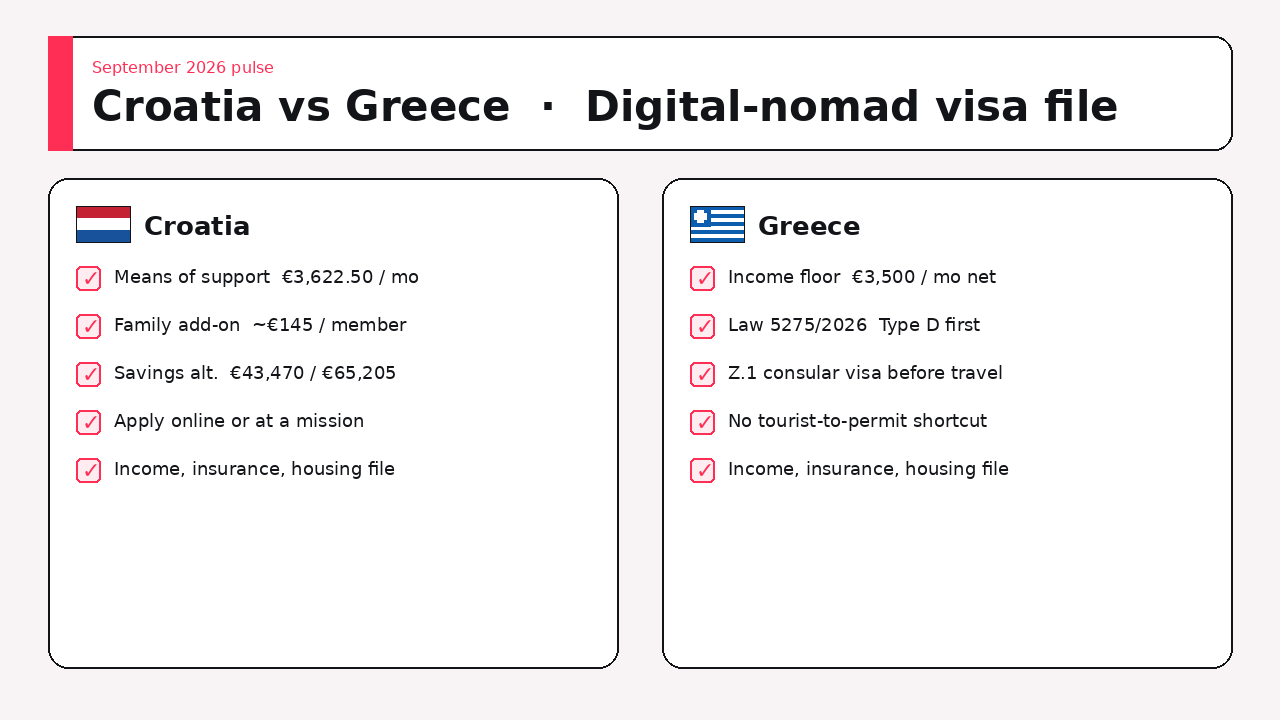
If your plan was “fly into Athens on a tourist stamp and convert later,” that door is shut. Greece’s Law 5275/2026 pushed the first step back to a consular Type D visa. Croatia did not copy that trick — it moved the number: means of support now sit at €3,622.50 a month on the Interior Ministry page, which is 2.5× the 2025 average net wage. This is the September 2026 file checklist: income pack, insurance, housing, where you actually apply. It is a sourced summary, not legal advice and not a permit in your passport.
The pain: two Schengen options, two different clocks
Nomad chats still recycle 2024–2025 screenshots. Two of those screenshots will strand you:
- Greece “I’ll apply in-country.” Practitioner notes on Law 5275/2026 (published ΦΕΚ Α' 17 / 6 February 2026) say the old tourist / visa-free route into an initial digital-nomad residence permit is gone. You get the national Type D first — residence title Z.1 — from a Greek consulate, then you enter, then you file for the permit. Landing on 90/180 and hoping the Decentralised Administration will take the file is the 2025 move.
- Croatia “€3,295 is still the floor.” That figure tracked an older average net. The live Interior Ministry page cites the Regulation on means of subsistence (Official Gazette 14/21 and 3/26): 2.5× last year’s average monthly net. Croatian Bureau of Statistics data put 2025 average net at €1,449. 2.5 × 1,449 = €3,622.50 — which is the monthly amount MUP publishes now.
Pick a lane this week. The income PDF, the insurance certificate, and the address you put on the form are the same three folders either way. The clock is not.
Snapshot (September 2026)
Read this as a field table, not a ranking. Confirm the live pages before you book a consulate slot.
| Check | Croatia (temporary stay of digital nomads) | Greece (Z.1 national visa → permit) |
|---|---|---|
| Who | Third-country national (non-EU/EEA/Swiss) working via comms tech for a foreign employer or own foreign company — not serving Croatian employers | Third-country remote worker / freelancer / self-employed serving employers or clients outside Greece |
| Income / means | Currently €3,622.50/mo (2.5× 2025 avg net €1,449), or savings €43,470 / €65,205 for 12 / 18 months | Statute: €3,500/mo stable resources; net of tax where the money is salaried / contract work (Art. 68 Law 5038/2023) |
| Family add-on | 10% of the average net per extra family member / partner — about €145 (0.10 × €1,449), not 10% of €3,622.50 | +20% spouse / partner and +15% per child, on the €3,500 base (in the same article) |
| Where you apply first | Online, or at a Croatian mission; visa-required nationals cannot use a police-station filing as the entry ticket | Greek consulate before travel for Type D / Z.1. The tourist-to-permit shortcut is the thing Law 5275/2026 closed |
| Stay shape | Temporary stay up to 18 months (shorter grants can extend; new nomad stay waits six months after expiry) | National visa up to 12 months; a two-year I.8-style permit may follow if you apply before the visa expires — that is a second file, not automatic |
Croatia checklist: income pack, insurance, housing, where to apply
Primary source: the Interior Ministry’s English page, Temporary stay of digital nomads. Documents in Croatian or English (authorised translation). Currency must be obvious on the PDFs. Max 2MB per file if you apply online.
Income pack
- Monthly path: bank statements showing regular income at the required monthly amount, or payslips for at least six months, at €3,622.50 (MUP’s current figure). Label the PDF so a case worker does not have to reverse-engineer your payroll app.
- Savings path (when you are showing a lump sum instead of the monthly drip): €43,470 already in the account for a 12-month stay, €65,205 for 18 months. Those are the same numbers MUP prints; they are 12× and 18× the monthly floor. Do not mix “I have three months of €3,600” with “I have €20k in savings” and hope they average it.
- Family: add ~€145 per extra member (10% of the average net, not of the nomad floor). Secondary blogs that add 10% of €3,622.50 are doing different maths than the regulation MUP cites.
- Purpose of stay: employment contract or signed letter that you work through comms tech for a foreign employer, plus the employer statement — or company registration plus proof you work through your own foreign company. You do not take Croatian clients on this status.
Insurance
Travel or private health insurance that covers the territory of Croatia for the period you plan to stay. A home-country policy that silently excludes “residing abroad” is a refusal waiting to happen. Put the territorial cover in the same PDF as the dates.
Housing / address
The form needs an address of stay or intended stay — that is how they pick the competent police administration. First application, no Croatian lease yet: MUP says a hostel/hotel reservation or confirmed accommodation is enough as the intended address. After the stay is granted you still register the real address (lease, title, or owner statement) and pick up the biometric card. Registering late is how people lose the stay they just won.
Where to apply
- Online is the default MUP describes. It routes to the police administration for your intended address.
- Visa-required nationals (MUP’s example: PRC passport holders): apply at a Croatian diplomatic mission / consular post, then get a long-stay D visa after approval. A police-station filing while you are in Croatia on a Schengen C is the application they say they will reject. A C visa also does not let you sit in Croatia until the nomad decision is enforceable.
- Visa-exempt nationals: mission abroad, or a police administration/station if you are already legally in Croatia. In that case you may remain until the decision is enforceable.
- Family members file family reunification after the nomad is granted. Applications submitted before that grant are rejected. Unmarried partners can qualify under the “common law” rules MUP points to — read that page; do not invent a three-year story on the form.
Published administrative fees live on the same MUP page and differ by mission vs police station. We are not reprinting a fee menu here; they move, and VFS add-ons are extra. Criminal-record certificates must be legalised. Passport validity: three months longer than the intended stay.
Greece checklist: Type D first, then the permit
Income and the Z.1 visa itself still sit in Article 68 of Law 5038/2023 (Immigration Code): national entry visa for digital nomads, up to twelve months, sufficient resources of €3,500 a month. Law-firm explainers of Law 5275/2026 — including Dafni I. Siopi (Feb 2026) and Georgallis & Partners — are aligned on the procedural punch: the option to skip the consulate and file an initial digital-nomad residence permit after a tourist or visa-free entry is abolished. You enter holding the corresponding Type D. Treat those pages as practitioner summaries of the gazette, not as a substitute for the consulate’s current checklist or a lawyer on your facts.
Income pack
- €3,500/mo is not a blog round-number. Article 68(2)(e) writes “τρεισήμισι χιλιάδες (3.500) ευρώ μηνιαίως.” Where the money is salaried or contract work, that floor is net of tax in the country the work is performed. Evidence: employment / project / service contract, or a bank account.
- Family maths is in the same paragraph: +20% for a spouse or cohabiting / civil partner (€700) and +15% per child (€525). That is a statutory surcharge, not a consular “guideline.”
- You also need the remote-work proof the code lists: sworn declaration that you will not work for a Greek employer; contract(s) with foreign employer(s) covering the visa period (freelancers: more than one); or, if you are self-employed, the foreign company details (name, seat, activity, purpose). Consulates have been asking for proof the foreign company actually exists — registry extracts, a live website. Pack that before the appointment.
Insurance
Insurance is required. National D-visa packets typically want travel cover for the visa period you are asking for; the later residence-permit file wants sickness cover that actually works in Greece. We are not inventing a “must be Schengen-specified €30,000” line from a random forum. Use the checklist your consulate publishes this month.
Housing
Croatia will take an intended hotel address on day one. Greece’s permit stage has historically wanted a lease, a purchase, or a concession of use — that is what the 2024 joint ministerial decision on supporting documents described. Law 5275/2026 changed who may file an initial permit after a tourist entry; it did not turn housing into optional flavour text. Have a stay you can document. Do not fly in, dump a suitcase in an Airbnb that forbids registration, and assume the Decentralised Administration will wait.
Where to apply
- Now: the Greek consular authority of your residence, for the digital-nomad national visa (Type D, coded Z.1). Article 68 says you can appear in person, email, or send registered post, and that the authority is to answer within ten days. That is a statutory clock, not a promise your local VFS queue will honour it.
- Not now: arriving visa-free or on a Schengen C and treating the 90 days as “permit processing time.” That is the shortcut Law 5275/2026 closed. Older 2024–2025 firm posts that still describe the in-country initial filing are describing the previous regime.
- After you enter on the D visa: the residence-permit application (often discussed as type I.8 in the code) goes to the Aliens and Immigration directorate of the Decentralised Administration where you live, before the visa expires. Family get individual visas that die with yours; they are not supposed to take Greek employment either.
Article 68 cites a €75 national-visa fee. We are not building a permit-fee table around that one line — card fees, VFS service charges, and I.8 amounts belong on the consulate / migration.gov.gr checklist you file against, not on a 2026 blog graphic.
This week’s file (do this, then book)
- Pick the country. If you cannot get a Type D appointment in time, Greece is not “I’ll sort it in Syntagma.” If you need 18 months on one grant and a savings lump sum, Croatia’s published alternative (€43,470 / €65,205) is the honest path. If your net is €3,500 but not €3,622.50, do not round Croatia up in your head.
- Income pack in one folder: six months of proof (Croatia’s payslip path) or the statute-ready contract + bank evidence (Greece). Family add-ons calculated the way that country writes them.
- Insurance certificate that names the territory and the dates. Screenshot the exclusion page so you know you are not lying to yourself.
- Housing artefact: Croatia — reservation with an address. Greece — a stay you can later put on a lease / concession, not a “friends couch.”
- Where-to-apply booking: Croatia online or mission (know your visa-required vs visa-exempt row). Greece: consulate / VFS for Z.1 before the flight. Put the appointment in the calendar first; the cheap fare second.
- Criminal record / passport validity / translations on the Croatia side; sworn declaration + company proof on the Greece side. These are the documents people leave until the appointment email lands.
Ready to stop collecting screenshots? Open the live Croatian MUP digital-nomad page or the Greek MFA national (Type D) visa instructions, dump the income-insurance-housing trio into one PDF set, and book the channel that page names. If the remote-work base is still the problem — income first, then a visa — back up to How to Become a Digital Nomad (2026).
After you land: data is not the visa, but it is the job
A Type D or a Croatian temporary stay does not include a working mobile pipe. Match the eSIM to the calendar — a consulate week is not a visa-run month — with the trip-length eSIM checklist, then compare exact-day vs fixed packs on eSIMEcho’s Holafly note (if that slug is still warming up, start from the eSIMEcho blog). Keep the home line off roam-as-default; the failure-mode version is when your home carrier bans roaming.
Sources
- Croatia, Ministry of the Interior — Temporary stay of digital nomads (means of support €3,622.50/mo; savings €43,470 / €65,205; family +10% of average net; where to apply).
- Croatian Bureau of Statistics 2025 average net wage of €1,449, as reported in English round-ups of the CBS release (2.5 × 1,449 = 3,622.50).
- Greece, Article 68 of Law 5038/2023 — digital nomads, residence title Z.1; €3,500/mo; +20% / +15%; €75 national-visa fee cited in the article. Gazette text via legal databases such as Taxheaven Art. 68.
- Greece, Law 5275/2026 (ΦΕΚ Α' 17/06.02.2026) — practitioner summaries: Siopi, Georgallis. We are not quoting the gazette as if this page were a certified translation.
Related reading
- How to Become a Digital Nomad (2026) — income first, then a visa file.
- Trip-length eSIM checklist — exact-day vs a week vs a month-plus once you have a landing date.
- eSIMEcho — destination connectivity notes after the stamp, not instead of it.
- Chiang Mai vs Bali vs Lisbon — city filters once the legal stay is not the open question.
Disclaimer
Field note, September 2026 — a sourced checklist, not legal, immigration, or tax advice, and not a complete document list for every nationality. Means-of-support formulas, consular practice, insurance wording, and “where to file” rules change without a blog’s permission. Law-firm explainers of Law 5275/2026 are secondary sources; the Croatian MUP page and the Greek Immigration Code are the primary ones we used for the numbers. Confirm the live official page and, if your facts are messy (prior refusals, mixed family status, visa-required passport), a qualified lawyer in that country before you pay a fee or board a plane. We are telling you to assemble a file. We are not telling you that you qualify.