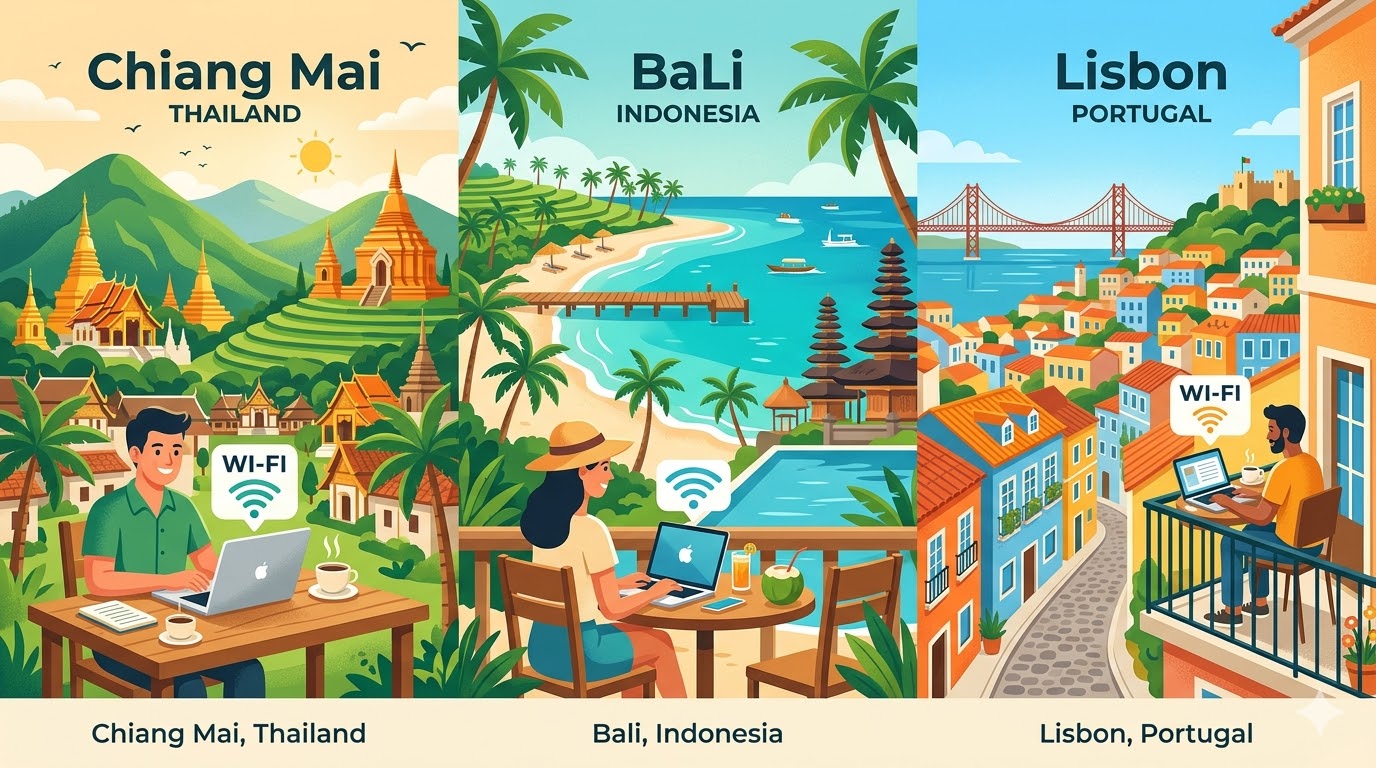
Look, I get it. You're staring at a map with three dots: Chiang Mai, Bali, and Lisbon. You've read the Medium articles. You've seen the Instagram reels of guys with expensive laptops drinking $3 lattes.
But you have a specific problem. Maybe you're running a few automation scripts that need decent upload speed. Maybe you're trading and need reliable power. Or maybe you're just tired of paying West Coast rent for a room with no windows.
I've spent time in all three. I've run my business from coworking spaces in Ubud, rented apartments in Lisbon's Alcantara, and sat in my Chiang Mai condo watching my bots do their thing while I ate Pad Thai.
Here is the honest breakdown, no fluff.
The Quick Reality Check
Chiang Mai is for the grinders. The guys who want to save 70% of their income and actually build something.
Bali (specifically Canggu/Ubud) is for the networkers and the "content creators." It looks cool, but it's getting expensive and crowded.
Lisbon is for the Europeans and the "serious" remote workers who still want nightlife and a timezone that works with New York.
Let's break it down by what actually matters.
Chiang Mai: The Digital Fortress
This is where I felt the most productive. Seriously. There is a reason the "Digital Nomad" thing basically started here.
The internet is stupid fast and stable if you pick the right condo. I was running Python scripts that uploaded large video files, and it never hiccuped. You can get a modern high-rise condo with a pool and gym for $400-$500 a month.
The Vibe: It's a college town for adults. Everyone is working on their startup, their coding bootcamp, or their online business. It’s less about the "vibe" and more about the output.
The Food: The best Thai food you'll ever eat, for $1.50 a plate. But honestly, after three months, you'll crave a burrito.
The Catch: The air quality from February to April is genuinely bad. Like, burning eyes bad. Also, the social scene can become a bubble. You're in Thailand, but you're living in a Western bubble of coworking spaces and malls.
Pros:
- Cost of Living: Unbeatable. You can live like a king on $1,200/mo.
- Infrastructure: 5G, fiber optic, modern malls (Maya, Central Festival). It feels more developed than most US cities in terms of convenience.
- Food: Cheap, accessible, world-class street food.
- Community: Huge nomad scene. Easy to find people building stuff.
Cons:
- Burning Season: It’s a dealbreaker for many. You'll need to leave for 2-3 months.
- Landlocked: No beach. You're in a valley.
- Not Walkable: You'll need a scooter or rely on Grab. It's spread out.
Bali: The Distraction Paradise
I wanted to love Bali. And I did, for about two weeks. Then I needed to get work done.
Canggu is a traffic nightmare. Getting 3km to a cafe can take 30 minutes. The internet in the villas can be spotty. I had to buy a backup 4G router just to ensure my trading bot didn't disconnect.
That said, if your "work" is taking Zoom calls and editing Instagram Reels, the aesthetic is unmatched. You can work with your laptop in a rice field.
The Vibe: Cool kids, yoga, surf, and smoothie bowls. It’s very "live your best life." It's amazing for a month, but for serious building? It’s harder.
The Food: Amazing healthy food. If you're into plant-based, organic stuff, this is heaven. Western food is cheaper than Lisbon but more expensive than Chiang Mai.
The Catch: The traffic will ruin your day. The prices have skyrocketed in the last 3 years. A decent villa is now $1,000+. You're also dealing with the "Bali Belly" risk if you're not careful.
Pros:
- Lifestyle: Surf, yoga, nature. It's unbeatable for work-life balance.
- Community: The biggest and most diverse nomad scene in the world.
- Aesthetics: Your friends will be jealous of your photos.
Cons:
- Internet: Unreliable in many accommodations. You must vet this.
- Traffic: Soul-crushing in the main areas.
- Cost: Inflated for what you get. You pay the "cool tax."
- Visa: The social visa process is more annoying than it used to be.
Lisbon: The European Hub
Lisbon is beautiful. The light, the architecture, the pastries. But your wallet will feel it.
I stayed in an apartment in Arroios. It was small, old, and cost €1,200 a month. You can find cheaper, but you'll be competing with 10 other people.
The upside? You're in Europe. Weekend trips to Spain, France, or Morocco are cheap and easy. The timezone works perfectly for East Coast US clients (12pm EST is 5pm Lisbon). For running automated systems, the infrastructure is top-tier. No power cuts, fiber everywhere.
The Vibe: More mature. People are here for the lifestyle but also have "real" jobs. It feels less like a nomad camp and more like a city.
The Food: Incredible if you like seafood and pork. Pastel de Nata every day. But dining out adds up fast.
The Catch: The housing crisis is real. It's hard to find a good place. Also, the city is hilly. You will walk 15,000 steps a day whether you like it or not.
Pros:
- Location: Gateway to Europe and Africa.
- Timezone: Best for US/EU clients simultaneously.
- Safety: Extremely safe city.
- Infrastructure: Rock-solid internet and power.
Cons:
- Cost: The most expensive of the three, by far.
- Accommodation: Difficult to find and expensive.
- Taxes: The NHR (Non-Habitual Resident) tax regime is changing/dying. Do your research.
The Comparison
Here is the cheat sheet. If you want to build wealth, go here. If you want to build a brand, go here.
| Feature | Chiang Mai | Bali (Canggu/Ubud) | Lisbon |
|---|---|---|---|
| Monthly Burn (USD) | $1,000 - $1,500 | $1,500 - $2,500 | $2,200 - $3,500+ |
| Internet Speed/Reliability | Excellent (Fiber) | Good / Spotty (Need backup) | Excellent (Fiber) |
| Time Zone (UTC) | +7 | +8 | +0 / +1 (DST) |
| Best For | Saving money, Coding, Trading | Brand-building, Yoga, Networking | Euro travel, Stable business |
| Food Cost | Very Cheap | Mid-Range | Expensive |
| Visa Run Hassle | Medium (30-day exempt/visa runs) | High (B211a visa needed) | Low (Schengen 90 days) |
| Social Scene | Grinders & Geeks | Creatives & Influencers | Professionals & Expats |
How to Actually Get Started (The Setup)
So you picked one. Here is how you don't fail on day one.
1. The Backup Internet Rule
In Bali, do not rely on the villa Wi-Fi. Go to a Telkomsel store on day one and buy a 4G/5G modem and a local SIM with a big data package. In Chiang Mai, use AIS or True. In Lisbon, MEO or Vodafone are solid, but honestly, the fiber in Airbnbs is usually fine. Always run a speed test before signing a lease.
2. The Power Check (For the Bot-Runners)
If you're running servers or mining rigs (even small ones), Lisbon and Chiang Mai have stable grids. Bali has "load shedding" (planned power cuts) in some areas during rainy season. Ask the landlord directly: "Apakah sering mati lampu?" (Do the lights often go out?).
3. Find Your Spot
- Chiang Mai: Look at condos like The Astra or Punna for high-end, or Hillside for budget. Use the "Hua Hin Property" or "Perfect Homes" FB groups.
- Bali: Do not book long-term online. Book a hotel for 5 days, drive around Canggu, and look for the "For Rent" signs. It's cheaper that way.
- Lisbon: Use Uniplaces for short-term, but for long-term, you need to join the "Expats in Lisbon" Facebook group. Landlords post there because Idealista is too crowded.
The Final Verdict
For Beginners: Go to Chiang Mai.
Honestly, it’s the easiest on-ramp. The cost is low, so if you mess up your budget, you're fine. The infrastructure is built for people like you. You can focus, save money, and actually get your projects off the ground without the distraction of a wave pool or a 15-euro dinner. It forgives mistakes.
For Advanced Users: Go to Lisbon.
If you already have the income, if your business is stable, and you don't want to deal with the chaos of Asia, Lisbon is the move. It's a real European city. The quality of life is high, the travel opportunities are endless, and you don't feel like you're "roughing it." You're just living a good life in Europe for slightly less than London or Paris.
Bali? Go there for a holiday. Or if you're a content creator who needs the aesthetic. For pure business building? It’s the hardest of the three.
Choose your hard.